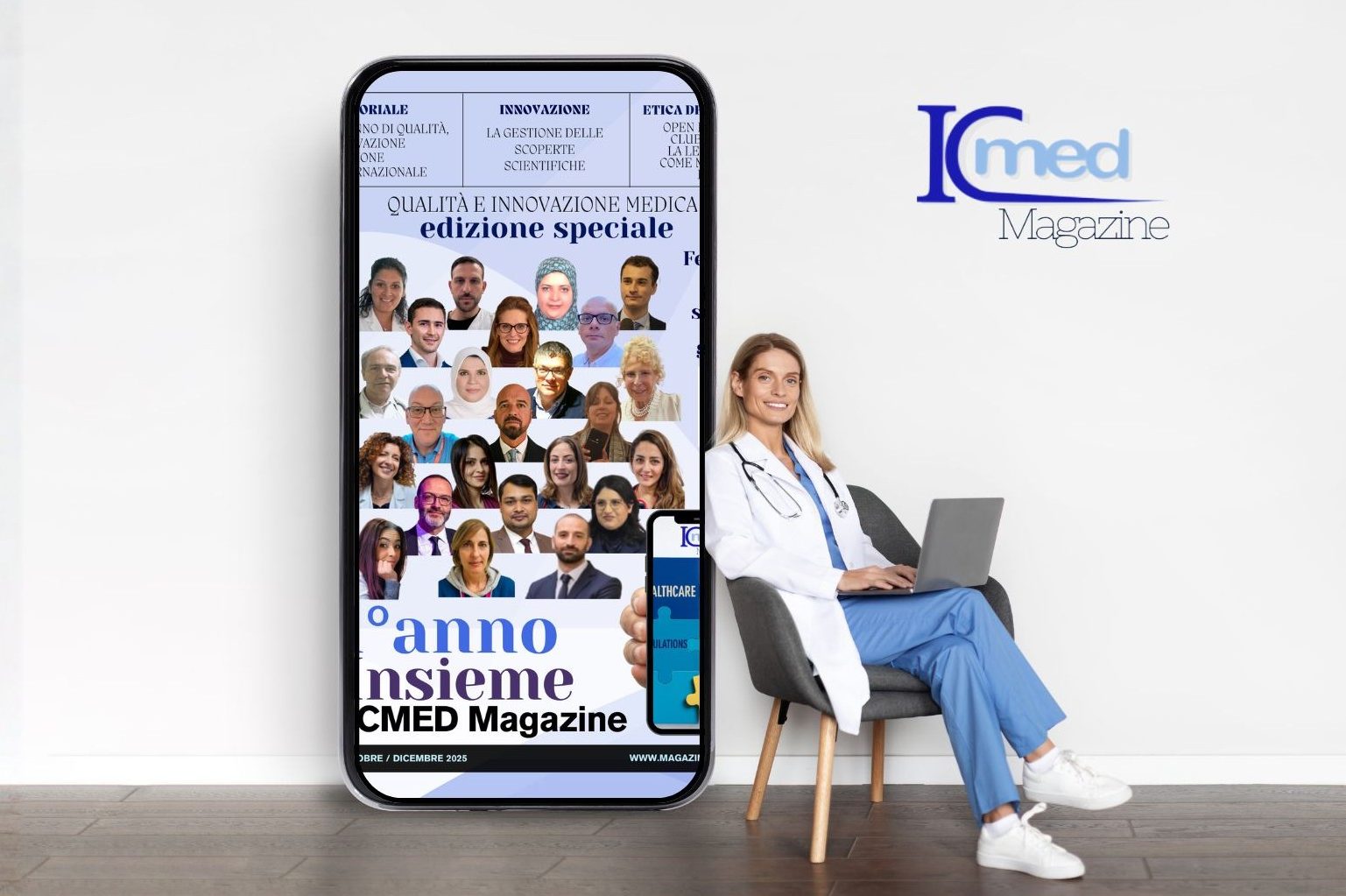

Contemporary health care is going through a phase of profound transformation, driven by the need to combine organisational quality, technological innovation and the development of professional skills.
In this issue of ICMED magazine, we propose a wide-ranging and articulated reflection on these strategic issues, with an eye in particular to highly specialised healthcare realities, which require increasingly high quality standards.
The collected contributions analyse continuous improvement through operational tools such as the EBM Walk Around, the increasing centrality of the Quality Manager and the importance of an evidence-based approach in the accreditation of complex healthcare pathways.
The contributions also analyse the importance of an evidence-based approach in the accreditation of complex healthcare pathways.
Technological innovation emerges as a transversal thread: from the computerisation of clinical-organisational processes, to the use of big data for personalised treatment and early diagnosis, to the application of artificial intelligence in reproductive medicine.
Particular attention is also paid to the evolution of professional profiles, such as the role of nurses responsible for quality in highly complex programmes, and to validation and validation processes, which are increasingly central to the management of highly specialised healthcare activities.
The issue also focuses on the development of the role of nurses responsible for quality in highly complex programmes.
Making this issue particularly significant is the participation of authors from international realities, whose experiences and perspectives enrich the debate and offer a broad view of the challenges and opportunities of modern healthcare. Quality, innovation and international openness are confirmed as essential tools for building a more effective, resilient and future-oriented healthcare system.
Vincenzo Iaconianni
ICmed Magazine