There is a word that for some time now has begun to be heard in conversations among doctors, trainers, researchers and young students of digital health: metaverse.
A term that seems to belong more to the language of gamers or computer engineers, but which is actually knocking on the doors of hospitals, universities and our own care relationships.
The first time I dealt with it, I was fascinated because, for me as a doctor “humanist”, it was surprising that the real and the virtual, could be combined into a whole that amazes and enchants.
The fascination of the metaverse stems from here: from its being boundary and promise, threshold and possibility.
È the space where the real and the virtual meet, not to exclude each other, but to generate new forms of presence, new modes of experience, new dimensions of empathy.
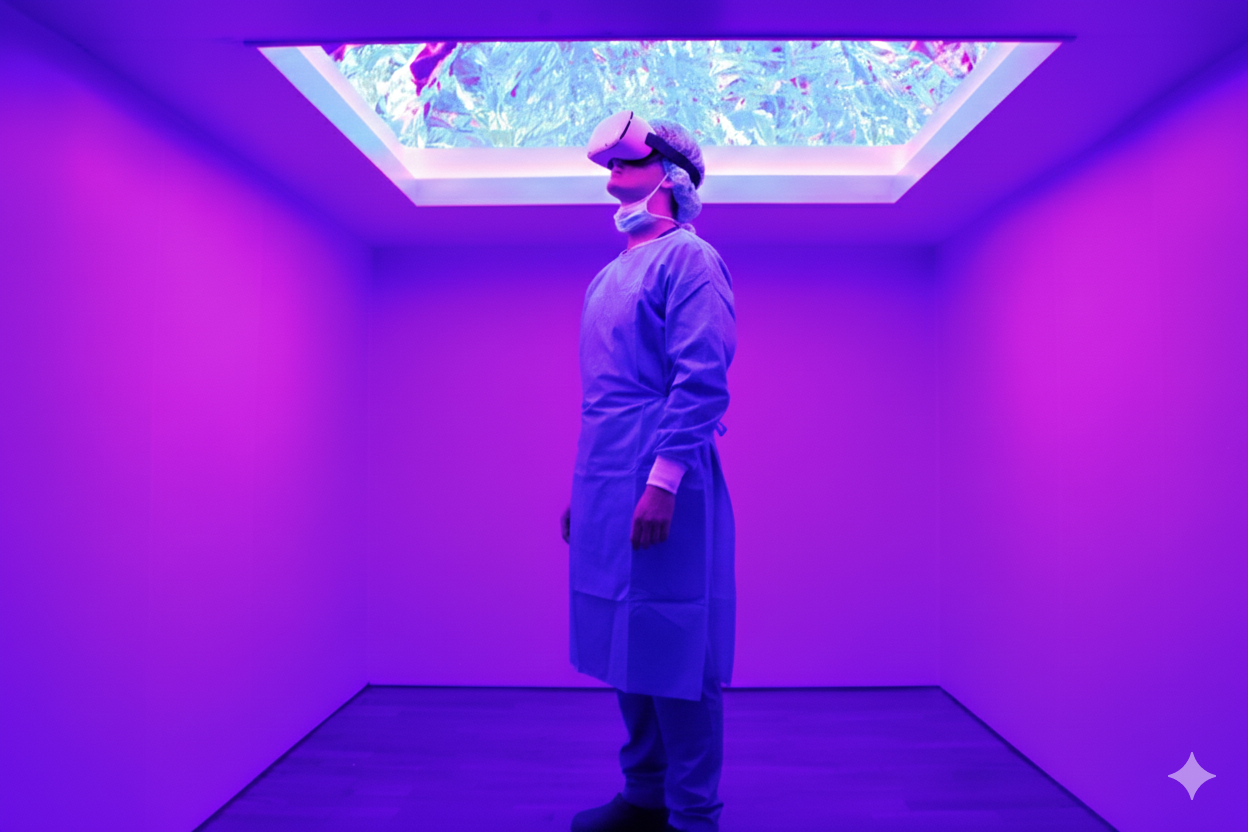
I imagined myself, as a student, putting on a visor and finding myself catapulted into a virtual operating theatre, surrounded by colleagues- avatars and perfectly reproduced digital instruments, and I “fell in love” with a future that è already is today.
Every gesture, every word, every decision becomes an opportunity to learn, without risk for the patient, but with the same emotional intensity as the real thing.
The metaverse allows to learn, to make mistakes, to go back, to observe from several points of view.
&Esgrave; an experiential laboratory where healthcare training is transformed from lecture to simulated life, from theory to immersion.
It is no longer the classroom that contains the experience, but the experience that becomes the classroom.
TheLearning is not the classroom, it is the experience that becomes the classroom.
Thefascination of the metaverse is not only technological, itsfascination is also profoundly human.
When two avatars meet in a digital space, it is not only their graphical representation that communicates: it is our mind that builds bridges, it is our imagination that creates a true relationship.
When two avatars meet in a digital space, it is not only their graphical representation that communicates: it is our mind that builds bridges, it is our imagination that creates a true relationship.
The metaverse is not only technological, it is also deeply human.
In this sense, the metaverse reinvents the encounter, making it “truly” virtual and does not take away its human depth.
It allows creating empathy at a distance, sharing a glance even when miles separate, generating a sense of belonging in communities dispersed in physical space, but united in the project of care.
We have become “global”, technological, but we do not want to lose the ’humanity” which is an irreplaceable value.
The metaverse has also made me see a poetic dimension to it that healthcare cannot ignore.
In the metaverse, the body of the patient and that of the caregiver can find new forms of presence and listening.
Immersive rehabilitation paths can be imagined, where the patient explores landscapes of light and sound to regain confidence in his or her own body.
We can create therapeutic environments where the fear of the hospital dissolves in a digital garden, or where a child undergoing cancer treatment meets his or her doctor in a magical, reassuring space, far from the smell of disinfectants and the metallic noises of the wards.
The allure of the metaverse è thus also an ethical challenge.
It forces us to ask ourselves where man ends and the machine begins, what remains authentic when the relationship takes place in a space without gravity.
The metaverse is also an ethical challenge.
But perhaps it is precisely in this questioning that the metaverse reveals its power: it forces us to reflect on the value of presence, on the meaning of care, on the responsibility that accompanies every digital gesture.
The technology of the metaverse is not a digital gesture.
Technology does not replace humanity, but forces it to redefine itself.
In the wards of the future, I imagine seeing not only gowns and stethoscopes, but also viewers, sensors, immersive environments.
And yet, what will continue to make the difference will be the gaze, the word, the breath shared between the carer and the cared for.
The metaverse will be able to amplify, not replace, this profound attunement.
È as if we were facing a new dimension of the possible: a medicine that does not renounce the concreteness of the body, but opens a gateway to a broader understanding of human experience.
Maybe the fascination of the metaverse stems precisely from this paradox: the more we immerse ourselves in the virtual, the more we feel the need for the real and for humanism.
The more we explore digital worlds, the more we long for authentic contact, living presence, real voice.
And then, perhaps, the real challenge will not be to build hospitals in the metaverse, but to build a metaverse of the soul, where technology becomes not a wall but a bridge, not a screen but a gaze, not an escape but a return.
The metaverse is not an elsewhere: it is a new dimension of the here.
A laboratory where science meets wonder, where medicine becomes experience, where cure becomes journey. And it is in this journey that the health care of the future can rediscover its most ancient essence: the ability to imagine, to bring two souls together, to heal also through relationships.
The health care of the future is a new dimension of the here.
Because, after all, the fascination of the metaverse è is the same as the fascination of healing: an act “d’d’love” that unites different worlds, the real and the virtual, in a single human horizon.
I want to believe that it is possible “a rediscovery of the human while immersed in the most high technology, because only in this way will the “machine not dominate the world but be the bearer of favourable and new winds".
Bibliography
- Huynh-The T., Pham Q.-V., Pham X.-Q., Nguyen T.T., Han Z., Kim D.-S., Artificial Intelligence for the Metaverse: A Survey, arXiv preprint 2022.
- .
- “Metaverse: the evolution of medicine and health services”, abstract available, publisher Aracne.
- “The metaverse and medicine: the prevention of chronic diseases, radiology, surgery, physician training”, article in Heart and… of 17 March 2023
- “Metaverse in Healthcare: examples, technologies and solutions”, Health Tech 360, 14 Dec 2022.
- “Metaverse and mental wellbeing: what risks we run and how to overcome them”, in AgendaDigitale, 4 May 2022.
- Vaiani R., Lecture «Complex Systems, Artificial Intelligence, Metaverse and Telemedicine», Master in Adapted Motor Sciences, Università e-Campus, 23/01/2025.
- Vaiani R., Master Lectures, e-Campus University, “Economics and Management of Complex Systems”, 2010.