
During this year's EBMT 2025 Annual Meeting, held in an atmosphere of great participation and scientific ferment, a poster dedicated to a topic still little explored in the international scientific literature aroused particular interest: the evaluation of the skills of the Quality Manager in stem cell transplant centres, according to a structured methodology inspired by the FACT-JACIE standards.
The poster, presented within the "Quality Management" section, is proposed as the first step towards the definition of a shared, objective and measurable model for the self-assessment of the role of the Quality Manager in the transplantation of stem cells.
The poster, presented within the "Quality Management" section, is proposed as the first step towards the definition of a shared, objective and measurable model for the self-assessment of the Quality Manager's role. The figure of the Quality Manager è is central to quality management in transplant programmes: not just a supervisor of procedures, but an active promoter of organisational culture, a guarantor of regulatory compliance and facilitator of continuous improvement.
A project with the participation of over 60 professionals
What made the study particularly original was the methodological approach adopted: the construction of the self-assessment questionnaire took place through an iterative process, involving over 60 Quality Managers from public, private and IRCCS facilities, distributed in different geographical areas of the world. A membership that testifies to the concrete interest in a tool that not only measures but also enhances the profession.
The model has identified five fundamental areas of competence:
1. Technical/regulatory competences, including in-depth knowledge of the FACT-JACIE standards.
2. Process and quality system management, with a focus on integration with other clinical-organisational areas.
3. Auditing and monitoring capabilities, in terms of effectiveness, non-conformities and corrective actions.
4. Document management and indicators, as operational and decision-making tools.
5. Transversal, relational and training skills, fundamental for the coordination of multidisciplinary teams.
Each area was explored through a series of assessable statements on a scale, which made it possible to generate an individual radar chart, useful for visually representing the competence profile of each participant.
The power of a visual and reflective approach
The use of the radar chart – a graphic form often adopted in management – allowed each Quality Manager to obtain, in an immediate and intuitive manner, a picture of his or her own positioning with respect to the five areas. This stimulated a constructive, non-judgmental reflection on his or her own role and training priorities.
One of the most appreciated elements, also reported during the poster presentation, was precisely the possibility of activating an internal and multidisciplinary discussion: in fact, many participants shared their experience with colleagues from their own centre, using the questionnaire as a basis for constructive discussions on organisational improvement.
The questionnaire was also used as a basis for constructive discussions on organisational improvement.
The importance of the JACIE framework
The reference to the FACT-JACIE standards is not random. The most recent 8th edition of these standards places a strong emphasis on defining the responsibilities and competences of professionals involved in transplantation programmes. The Quality Manager, according to JACIE, is not just an administrative figure, but a key element for patient safety, traceability of activities and the effectiveness of the quality management system.
The study presented showed how it is possible, through a simple and accessible tool, to transform standards into levers of professional growth, giving concrete form to requirements that otherwise risk remaining formal.
An open project: towards the creation of a dedicated portal
In the light of the interest aroused, and the value collected thanks to the active participation of professionals, an ambitious project is now being conceived: the creation of an open and free portal for the self-assessment of Quality Manager competences.
The aim è is to offer all professionals in the sector a simple, accessible and useful digital tool, enabling them to:
- fill in the questionnaire anonymously;
- visualise results via personalised radar chart;
- access targeted training content for each area of competence;
- participate in a community of practice, sharing experiences and operational strategies;
The portal will not have a commercial purpose, but will be promoted by a network of experts and scientific realities that will guarantee methodological rigour and independence.
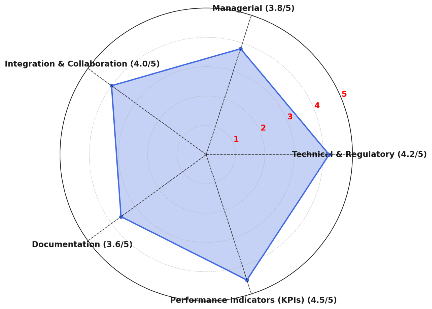
"Each area è was explored through a series of assessable statements on a scale, which allowed for the generation of an individual radar chart, useful for visually representing the competence profile of each participant."
An invitation to participation
This project was born from an idea, but wants to grow as a collective initiative. For this reason, an open consultation process will be launched in the coming weeks, aimed at gathering suggestions, endorsements and proposals from all those who wish to contribute to the development of the platform.
Participation in the EBMT 2025 congress è was the starting point of a journey that aims to bring lasting value to the Quality Manager community, promoting a culture of evaluation, awareness and continuous improvement.
In a time when quality can no longer just be declared, but must be experienced, measured and shared, this project represents a concrete opportunity to strengthen the role of the Quality Manager as a key figure in the healthcare of the future.