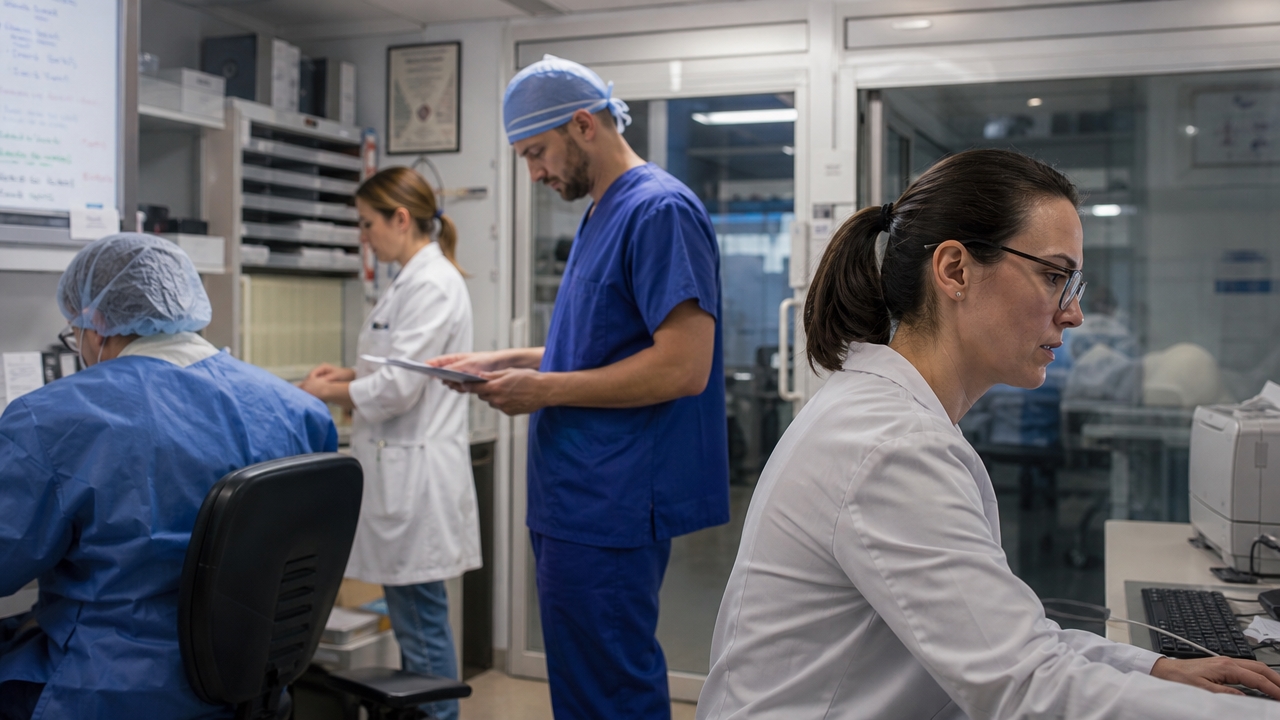
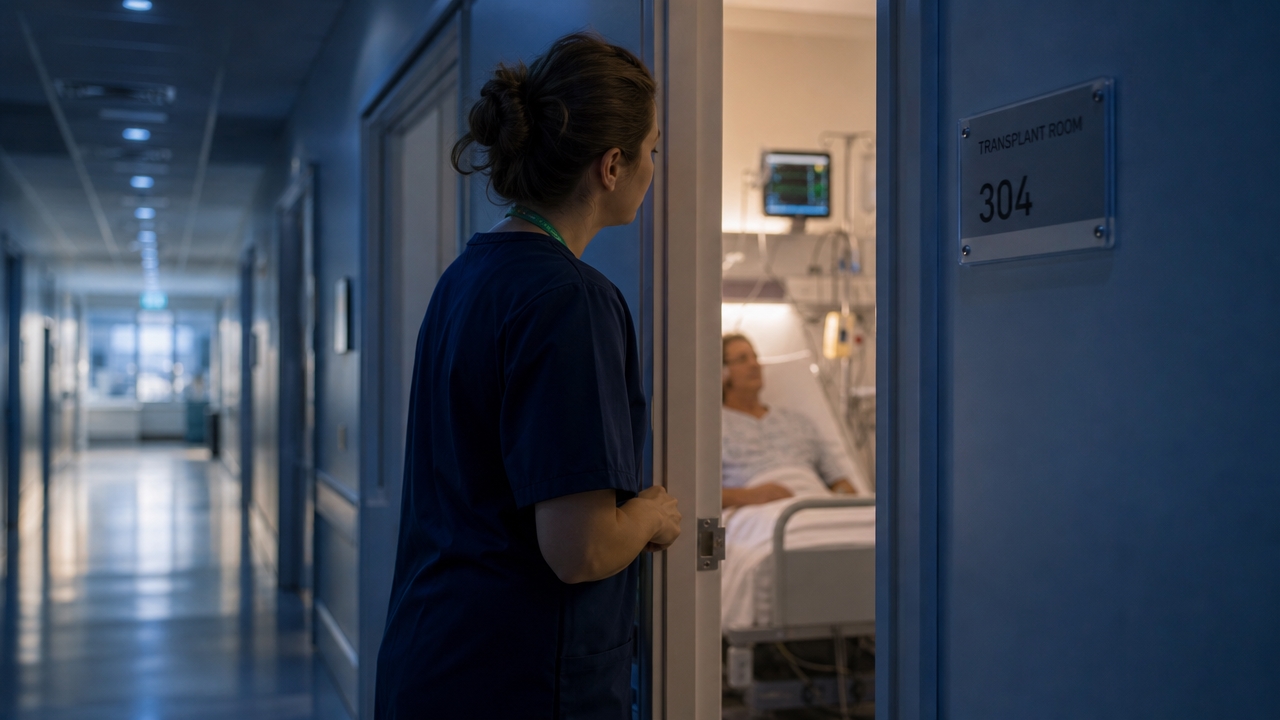
Anyone who has worked in a transplant unit knows the strange quiet of the post-conditioning days. Counts are bottoming out, the immune system is essentially gone, and the patient in front of you looks fine. That “looks fine” is the trap. In this population the worst complications rarely arrive with a flourish; they creep in. A temperature that drifts up half a degree overnight. A blood pressure that softens. A patient who is just more tired than yesterday and can’t quite say why. For as long as transplant nursing has existed, catching those signals early has come down to one thing: an experienced nurse paying very close attention.
That hasn’t changed. What has changed is that the nurse now has help.
A second set of eyes
Across haematology, machine-learning models are being trained to do something humans do poorly hold every data point on every patient in mind at once and notice the moment a pattern starts to bend. Sepsis is the clearest example. A large multi-site study of the early-warning system found that when clinicians acted on its alerts promptly, patients were identified and treated sooner, with a measurable reduction in mortality. Years earlier, a Kaiser Permanente programme published in the New England Journal of Medicine showed an automated model could flag deteriorating ward patients well before a conventional score would.
This isn’t a niche experiment anymore. Systematic reviews now catalogue machine-learning models predicting post-transplant survival, relapse, graft-versus-host disease, even oral mucositis, several of them reaching accuracy that rivals the risk scores we’ve leaned on for years. For patients in the neutropenic window, where the gap between stable and septic can be a matter of hours, that head start isn’t academic. It can decide whether cultures get drawn and antibiotics started inside the window that actually changes the outcome. The nurse still makes the call. The model just helps her aim her attention — which of the quiet patients on the unit deserves a closer look right now.
The same logic is being tuned to the syndromes peculiar to cellular therapy. For CAR-T recipients, models are now being built to predict high-grade cytokine release syndrome before it fully declares itself, some flagging the risk with enough lead time to ready tocilizumab or escalate early. One related tool has even shown it can help distinguish CRS from sepsis at the bedside, which is one of the genuinely hard calls in this work.
Precision where the margin is thin
Transplant runs on narrow windows, and that is exactly where these tools earn their keep. Take busulfan. Its pharmacokinetics vary wildly from one patient to the next and getting exposure wrong cuts both ways: too low risks graft failure or relapse, too high invites toxicity. Model-based dosing already outperforms weight-based rules of thumb. In one paediatric cohort, model-guided initial dosing placed 81% of patients within the target exposure range, compared with 52% using conventional dosing. The newer literature points squarely at AI and machine learning as the next step in tightening that margin further. For the nurse hanging the bag, decision support that re-checks the dose and catches the interaction adds a quiet layer of safety to a drug that doesn’t forgive mistakes.
Mobilisation and apheresis benefit too. Models can now forecast CD34+ yield with useful accuracy before collection even begins one predicted the harvested count closely enough to guide practice sparing patients repeat procedures and sparing the apheresis team the demoralising failed first run.
Giving the hours back
Ask a transplant nurse where her shift actually goes and a depressing share of the honest answer is: charting. One analysis put it at roughly a third of a twelve-hour shift spent on flowsheet documentation alone. This is where AI may land its least glamorous but most deeply felt blow. Ambient documentation tools listen to the encounter and draft the note in the background, and early adopters are reporting real returns; nurses at one US health system have described getting close to two hours of charting time back per shift.12
The outcome that matters there isn’t the accuracy of a note. It’s presence. Every hour handed back is an hour freed for the bedside assessment, for actually looking at the patient, for sitting with someone frightened and alone in isolation. In a specialty where psychological care does real clinical work, letting the nurse be a nurse again is not a soft benefit.
The part that keeps it honest
None of this comes for free and pretending it does would be a disservice. The biggest practical problem with early-warning systems is that they cry wolf. Because the events they predict are rare, even a strong model can throw alerts that are wrong most of the time one recent analysis described a high-performing tool whose alerts were false positives nearly nine times in ten. Flood a unit with those and nurses stop trusting any of them, which is worse than no alert at all. Then there’s bias. A model trained on a narrow population can quietly underperform for the very patients already most underserved, and in a city as demographically mixed as Dubai that is not a hypothetical worry. And there’s the subtler trap of automation bias, where a team leans on the tool until the skill it was meant to support begins to fade.
The answer isn’t to slow down. It’s to govern well: validate models in your own population before trusting them, keep the nurse firmly in the loop, and treat every output as a prompt to think rather than an order to obey.
Conclusion: A partnership, not a handover
The transplant nurse of the next decade won’t be replaced by an algorithm. She’ll be backed by one her vigilance stretched across more patients and more data, her medication safety reinforced, her hours returned to where they belong. The three-in-the-morning instinct that something is wrong will stay stubbornly, irreplaceably human. For the first time, though, that instinct will have a tireless partner watching alongside it. In a field where catching the quiet signal early is so often the whole game, that may prove one of the more consequential shifts in transplant nursing in a generation.