Why the safety of an IVF cycle depends less on the machines a laboratory owns than on the discipline of never losing track.
Every IVF cycle carries a quiet promise: that the right embryo reaches the right parent, and that nothing entrusted to the laboratory is ever lost. The fundamentals are the same everywhere. What a laboratory can keep depends on what it can afford. A view from India, and a story shared across South Asia.
The price of a broken chain
On a quiet weekend in March 2018, two American fertility centres suffered cryostorage failures within days of each other. No scientist failed. No technique fell short. At one, in Cleveland, the remote alarm meant to warn an on-call embryologist that a tank was slowly warming had been switched off. Across two silent nights, nearly four thousand eggs and embryos warmed past saving.1 How does a field this advanced, one that can spark life in a dish and read the chromosomes of a single cell, still lose everything to something so small? The answer is the least glamorous word in the laboratory. Traceability. And what happened in Cleveland could just as easily happen in Chennai.
More than mixing up an embryo
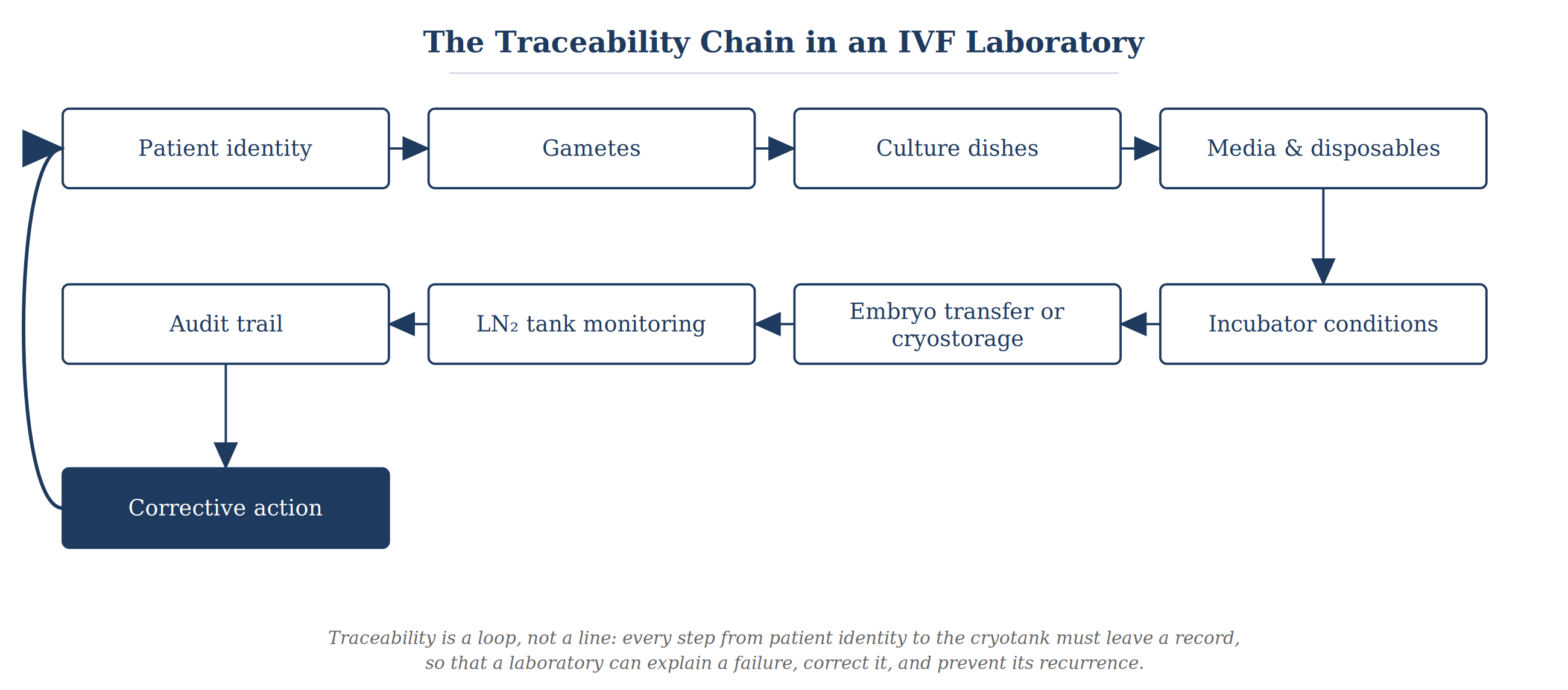
We usually picture traceability narrowly: the right sperm meeting the right egg, the right embryo going back to the right woman. That matters enormously, but it is only half the story. Traceability has a second face, and embryologists feel it most on the days something goes wrong. A fertilisation rate collapses. A batch of embryos arrests. A culture turns. When that happens, the only thing that saves you is the ability to look back and ask what changed. Which lot of media was open that morning? Was it the gametes? Had the air quality slipped? Without records tying every variable to every cycle, you are left guessing. With them, you can find the culprit and correct it. This is the real spine of quality management: not just preventing the wrong embryo, but explaining the failed one.11
That chain runs through everything the laboratory touches: the media and disposables, each with a lot number and expiry; the liquid nitrogen and the freezers that hold years of life at minus 196 °C. A break anywhere is as grave as a mislabelled dish, and traceability is, ultimately, supply-chain safety in a laboratory coat.
What the world has built
Some systems have grown up around this. In Europe, every donated gamete and embryo has to be traceable from donor to recipient and back, through a Single European Code that has been mandatory since 2017.2,3 The ESHRE–Alpha Vienna consensus laid down nineteen indicators a laboratory can measure itself against.4 Electronic witnessing uses radio tags or barcodes so only one patient’s samples sit at a bench, and over a decade it has kept mismatch events to roughly one in a thousand witnessing steps.5 But enthusiasm needs a check. Time-lapse incubators and AI scoring promise objectivity, yet few laboratories own them, and many that do cannot spare the hours the annotation still takes. AI could carry that load,6 though its price decides who gets to use it. In the largest trial so far, deep-learning selection was not shown to beat an experienced embryologist’s judgement.7 For now, the machine sharpens human judgement. It does not replace it.
A tale of two Indias
Across South Asia the challenge is the same, and in India it becomes a tale of two countries inside one. In the first, the big private chains run more time-lapse incubators than some nations own, and witnessing and traceability systems that were rare here a few years ago are spreading fast. In the second, out in the tier-three towns and the smaller cities, laboratories with just as much skill work without a single one of these machines. Of the thousands of fertility centres across the country, only a fraction have such tools. India has everything and nothing at once.
The reasons are cost and structure. One witnessing system can cost a small clinic its whole yearly margin. You will find a centre with a gleaming incubator that still logs its nitrogen in a paper notebook, or runs flawless ICSI through an afternoon power cut. The quieter problem runs deeper. IVF in India, as in much of South Asia, is almost entirely private, and the universities that usually drive research rarely run fertility units. So the research engine that would let India generate its own evidence is only beginning to take shape. India is shaping its own response: there is now a national registry of clinics,8 and the ISAR consensus guidelines that spell out what is expected for patient and gamete traceability, for consumables, for laboratory indicators.9,10 Neighbouring countries face the same challenge, each at its own stage of response. What is short is not ambition but reach, and reach can be built.
What can be done
None of this calls for despair. Traceability does not start with a purchase. It starts with habits that cost very little: one patient at a bench, honest witnessing, written steps people actually follow, and faithfully kept logs of nitrogen, media and incubator readings. After that the climb is tiered: lock down the cheap foundations first, add electronic witnessing next for the most safety per rupee, then reach for AI where volume and local validation justify it, always with a human making the final call. The principles are universal: a shared identity code, a culture of records, a habit of checking and re-checking. India can shape them to its own context, and build the research centres that let it generate its own evidence and add to the wider picture.
The take-home
If one thought follows you home, to New Delhi or to Rome, let it be this. Traceability is not a luxury you buy once the budget allows. It is a way of working, open to any laboratory by tomorrow morning, that treats every gamete, every embryo and every tank of nitrogen as both a fragile life and a record that must never break. Even one mismatch in a thousand is one too many when a family’s only embryos are at stake. So the bar has to rise. In the language of quality, the goal has a name: Six Sigma, error measured in a few parts per million. For something as precious as an embryo, that is the right ambition. The machines will keep getting better, but the habit has to come first, along with the humility to leave the alarm switched on. The work that is left, for a society and for every embryologist in it, is to make that habit ordinary rather than exceptional, so that the India of everything and the India of nothing become a single India that simply keeps its word.
References
1. Cleveland University Hospitals Fertility Center cryostorage failure, March 2018 (approximately 4,000 eggs/embryos, ~950 patients; remote alarm deactivated); a separate failure occurred days earlier at Pacific Fertility Center, San Francisco. News reports and subsequent CMS investigation. Available from: https://www.nbcnews.com/news/all/heartbreak-anxiety-lawsuits-egg-freezing-disaster-year-later-n978891
2. Commission Directive (EU) 2015/565 amending Directive 2006/86/EC as regards traceability requirements and the Single European Code for human tissues and cells. Off J Eur Union. 2015. Application of the SEC from 29 April 2017. EUR-Lex CELEX:32015L0565.
3. Alteri A, Vermeulen N, Rugescu IA, et al.; ESHRE SIG Safety and Quality in ART. Coding in medically assisted reproduction: implementation of the Single European Code for reproductive cells and tissues. Hum Reprod Open. 2020;2020(3):hoaa027. doi:10.1093/hropen/hoaa027.
4. ESHRE Special Interest Group of Embryology; Alpha Scientists in Reproductive Medicine. The Vienna consensus: report of an expert meeting on the development of ART laboratory performance indicators. Reprod Biomed Online. 2017;35(5):494–510. doi:10.1016/j.rbmo.2017.06.015.
5. Sterckx J, Wouters K, Mateizel I, Segers I, De Vos A, Van Landuyt L, Van de Velde H, Tournaye H, De Munck N. Electronic witnessing in the medically assisted reproduction laboratory: insights and considerations after 10 years of use. Hum Reprod. 2023;38(8):1529–1537. doi:10.1093/humrep/dead115.
6. Berntsen J, Rimestad J, Lassen JT, Tran D, Kragh MF. Robust and generalizable embryo selection based on artificial intelligence and time-lapse image sequences. PLoS One. 2022;17(2):e0262661. doi:10.1371/journal.pone.0262661.
7. Illingworth PJ, et al. Deep learning versus manual morphology-based embryo selection in IVF: a randomised, double-blind, non-inferiority trial. Nat Med. 2024. doi:10.1038/s41591-024-03166-5.
8. The Assisted Reproductive Technology (Regulation) Act, 2021 (Act No. 42 of 2021). Government of India; Gazette of India, 21 Dec 2021. National ART & Surrogacy Registry: https://registry.artsurrogacy.gov.in
9. Malhotra J, Malhotra K, Talwar P, Kannan P, Singh P, Kumar Y, Chimote N, et al. ISAR consensus guidelines on safety and ethical practices in in vitro fertilization clinics. J Hum Reprod Sci. 2021;14(Suppl 1):S48–S68. doi:10.4103/0974-1208.330504.
10. Malhotra J, Malhotra K, Majumdar G, Hari R, Chelur V, Kandari S, Sharma D, Chimote N, et al. ISAR consensus guidelines on preimplantation genetic testing in in vitro fertilization clinics. J Hum Reprod Sci. 2021;14(Suppl 1):S31–S47. doi:10.4103/0974-1208.330503.
11. Rienzi L, Bariani F, Dalla Zorza M, et al.; Italian Society of Embryology, Reproduction and Research (SIERR). Comprehensive protocol of traceability during IVF: the result of a multicentre failure mode and effect analysis. Hum Reprod. 2017;32(8):1612–1620. doi:10.1093/humrep/dex144.