
It is a silent promise that underlies every aspect of highly complex medicine. It is the promise that the right thing will reach the right person — the amniotic sac, the embryo, the experimental drug — and that, if anything goes wrong, we will be able to trace the path back: from the patient’s bed to the donation, and forwards again, to every other recipient from that same source. That promise has a clinical name that does not do it justice: traceability.
Traceability is not merely a compliance requirement: it is the way in which trust becomes visible and safety measurable. A blood bag, as Priya Prasad reminds us, is never anonymous – every bag has a name, a story, a destination and a trail that can be followed. The same applies to every IVF cycle, where — as Nishad Chimote and Manisha Vajpeyee from India explain — safety depends less on machines than on the discipline of never losing track, from gametes to liquid nitrogen that preserves years of life at minus 196 degrees. And it applies to every experimental drug, whose journey from enrolment to follow-up – as reconstructed by Anna Maria Della Corte and Valentina Giudice – must be governed by procedures that ensure, at every moment, that the right product reaches the right patient.
A chain, however, is only as strong as its weakest link. And the links that give way are nothing out of the ordinary: a wrong label, an unchecked wristband, an alarm switched off one weekend in March. The 2018 failures at American cryostorage facilities, and the right bag hanging from the wrong bed, all point to the same uncomfortable truth: the supply chain breaks down where identity is lost, not where technology is lacking.
Yet the chain is getting longer. Nick van Sinderen warns us of a complexity that is growing faster than our ability to cope with it: new advanced therapies, the European SoHO Regulation, multiplying obligations, a multi-ATMP future in which what was once manageable for a single programme risks overwhelming those working on the front line. The question is not whether innovation should continue – it must – but how to ensure that it strengthens care without overwhelming those who deliver it. This is where technology can give back what it has taken away:artificial intelligence, as Naglaa ElWkil demonstrates, does not replace nurses in transplant wards but provides them with a second pair of eyes, anticipates complications that have not yet manifested, and frees up the hours previously taken up by paperwork. On one condition: that it remains a tool to be managed, with the professional always at the heart of the decision-making process, never on the sidelines.
And when, despite everything, does the chain break? It is the most difficult trail to follow, and the most important. Behind every mistake there is a professional who, in turn, becomes a second victim. Tracing that chain back – as Tommaso Mannone urges us to do in his reflection on just culture and the learning organisation – is not about punishment, but about learning. An organisation that knows how to look after those who have made mistakes is an organisation that learns: not out of generosity, but out of intelligence. The difference between treating that suffering as a problem and embracing it as a resource is not a technical one. It is a moral one.
Finally, there is a link that we rarely associate with the word ‘supply chain’, and it is perhaps the most revealing. A system is truly accountable only when nothing and no one falls outside the field of vision — including the inequalities that nobody measures. Global healthcare remains ‘delivered by women, led by men’: tracking this too follows the same logic as JACIE accreditation or ISO 15189 — it is measured, documented and improved. It is the logic that we at ICMED have chosen to apply, first and foremost to ourselves, before applying it to others.
Because this, after all, is the common thread running through these pages. Traceability and supply chain security are not just about barcodes and procedures: they are about the discipline of never losing track — of a product, a clinical sign, a mistake, a person, or an uncomfortable truth. Every scan, every check, every indicator recorded with honesty upholds the same, age-old promise: that nothing and no one along the way should be lost.
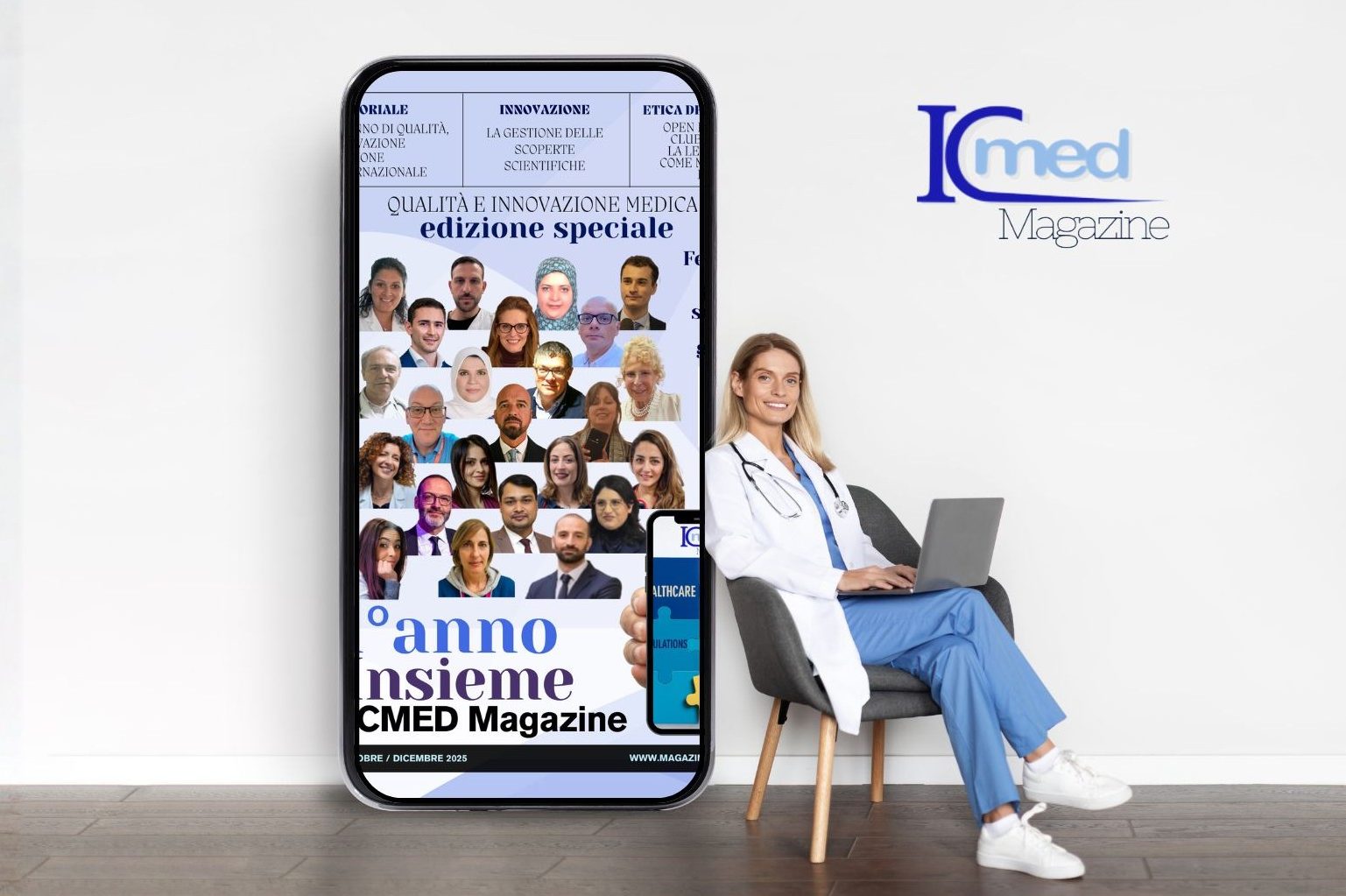
One final note, which we are proud to share. With this issue, ICMED Magazine has been assigned its own DOI: each article thus receives a permanent identifier that can be cited and traced forever. This is, on closer inspection, the most literal application of the theme of these pages — even knowledge, now, has a name that will not be lost — and the recognition that makes our publication, to all intents and purposes, a scientific journal. We are proud of this, and we dedicate this milestone to those who write these pages and to those who read them.
Enjoy the read.