
Bianca Cuffa, Daniela Pellegrino, Elvira Di Benedetto, Valentina Giudice, Bianca Serio
Centre of Haematology and Transplantation, AOU “San Giovanni di Dio e Ruggi d’Aragona”, Salerno, Italy
The concept of competence in healthcare refers to the ability to effectively and responsibly apply theoretical knowledge and practical skills in patient management and in the implementation of care guidelines and protocols. This concept implies continuous training activities, necessary to ensure that knowledge and skills are always aligned to current standards and in accordance with current regulations.
Continuous training of healthcare personnel may take place in the form of theoretical (training events, internal and external courses) or practical (field training, simulations, shadowing, use of diagnostic and therapeutic tools) . Competencies must be assessed periodically for regular updating and expected results. This process makes it possible to guarantee the operational appropriateness of the operators and the maintenance of quality and safety standards in transplantology pathways.
Nursing competencies in the Transplantation Programme
In the context of a Transplantation Programme, nurses must:
- collaborate in the implementation of the work plan
- provide care according to protocols and procedures;
- receive patients and establish priorities with the medical staff;
- compile and manage clinical documentation;
- assist during visits and in ongoing monitoring;
- participate in meetings and departmental update activities;
- manage nursing documentation;
- communicate with patients and caregivers;
- collaborate with doctors and technicians;
The specific core competences include:
- management of new admissions and immunocompromised patients;
- vascular access management;
- pain management;
- administration of drugs, supportive therapies and conditioning schemes;
- management of side effects and post-transplant aplastic phase;
- management and administration of blood products;
- recognition and management of post-transplant complications;
- management of emergencies;
- infection management and prophylaxis;
- Terminal patient care and caregiver support;
These competencies are based on the International Standards for Accreditation in Cellular Therapy (JACIE) and the GITMO Guidelines (Gruppo Italiano Trapianto Midollo Osseo) . In particular, nursing competences must be defined and verified annually according to section B3.6 of the JACIE standard v8.2 (2022): B3.6.1, B3.6.1.1, B3.6.1.2, up to B3.6.4.
Final Evaluation and Critical Issue Management
The final evaluation of the course is the most important moment of the training, in which it is determined whether the healthcare professional is ready to work independently within the Transplantation Programme. This process must be formalised by means of special evaluation forms containing all the competences required by the JACIE guidelines.
The newly recruited staff member must achieve a pre-established minimum score; if this is not the case, the mentor must inform the Unit Director, the Quality Manager and the Transplant Programme Director in order to initiate corrective actions, including supplementary training activities.
Application of the model in practice
This model è been implemented at the CIC928 Transplant Centre, AOU “San Giovanni di Dio e Ruggi d'Aragona” di Salerno, as a tool for training healthcare personnel and maintaining competences. If criticalities emerge, the causes are analysed and preventive and corrective actions are initiated.
The nursing staff, consisting of 20 units, uses two separate modules:
- Module for new recruits (self-assessment + mentor evaluation), with a scale of 1 (minimum) to 4 (maximum), carried out at 6 months and 1 year after recruitment.
- Annual Skills Maintenance Form.
Results 2023 and 2024
In 2023, for the 2 newly recruited nurses, the lowest self-assessments concerned the following topics:
- “Collaboration in the organisation of training courses”
- .
- “Participation in continuing education courses”
The assessments of the tutors scored 2 in 63% of the cases (29 questions), and 3 in 35% (16 questions). Only in one case was there a negative assessment (2%) and no excellent assessment (score 4). However, the comparison showed self-critical consistency on the part of the staff, with no overestimation of their own competence.
In 2024, for the 5 new recruits, including 2 already assessed in 2023, a 1 point improvement was observed in each area compared to the previous assessment.
- One nurse scored 11 ratings of 4 out of 23 (48%) and 12 ratings of 3 (52%), with no deficiencies.
The other scored 5 scores of 4 (22%), 17 scores of 3 (74%) and only one score of 2 under the heading “Collaboration in the organisation of training courses”.
All in all, out of 115 self-assessments, staff gave themselves a score of 3 (51%) or 4 (41%). The lowest ratings were concentrated on:
- “Correct performance of critical procedures” (e.g. administration of chemotherapy, management of vascular accesses, transfusions, bone marrow aspirates),
- “Collaboration in the’organisation of courses”,
- “Participation in continuing education”;
The tutors expressed uniform evaluations, with one exception, confirming the good reliability of the evaluation system and the training value of the process. To address the critical issues highlighted in 2024, a training plan 2025 was adopted, with the inclusion of a dedicated course on the management of extravasation and chemotherapy spills.
The training plan 2025 will be completed in the next few years.
Conclusions
This strategy not only raises the level of care, but also has a concrete impact on clinical outcomes, improving the overall quality of healthcare services offered and ensuring greater patient safety through clinical practices tailored to individual needs.
A training programme is designed to ensure that patients are able to benefit from the best possible care.
A continuous, structured and up-to-date training programme is essential to maintain high standards of excellence in transplant procedures. By promoting constant updates on the latest scientific evidence, emerging technologies and international regulations, healthcare personnel will be able to operate with an increasingly high level of competence and in line with global best practices.
.
In this way, a virtuous circle is created, in which the improvement of the training system feeds the evolution of clinical practices, benefiting both the patient and the healthcare team. This process of continuous improvement not only increases the effectiveness of individual actions, but also reinforces a highly qualified working environment, able to tackle the daily challenges of clinical practice with precision and competence.
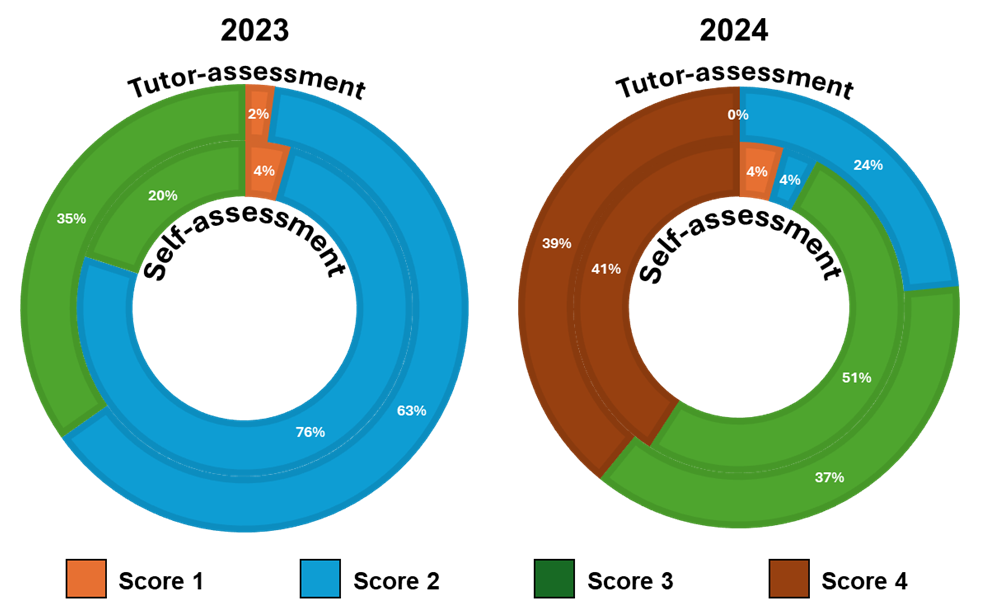
Self-assessment and assessment by the tutor in 2023 and 2024 of the nursing staff of the CIC928 Transplant Programme, AOU “San Giovanni di Dio e Ruggi d’Aragona” of Salerno, through a dedicated module consisting of 18 competences, assessed independently or by the tutor with a score from 1 (minimum) to 4 (maximum).

References
Salas, E., DiazGranados, D., Weaver, S. J., & King, H. (2008). Does Team Training Work? Principles for Health Care. Academic Emergency Medicine, 15(11).
Irvine, S., & Martin, J. (2021). Bridging the Gap Between Theory and Practice in Healthcare Education: Insights from a Blended Learning Approach. Journal of Medical Education and Curricular Development.
Carter, A., & Miller, J. (2020). Structured Evaluation Forms for Assessing Professional Skills. Medical Education Journal, 25(4), 225-232.
FACT-JACIE (2021). International Standards for Hematopoietic Cellular Therapy Product Collection, Processing, and Administration Manual (8th Edition).
GITMO (Italian Group for Bone Marrow Transplantation, Haemopoietic Stem Cells and Cellular Therapy). (2023). Handbook (Vol. III).
GITMO Nurses Section. (2015). Handbook (Vol. 1). Italian Group for Bone Marrow Transplantation, Haemopoietic Stem Cells and Cell Therapy (GITMO).