Cell Therapy Quality Research Health Pharma

Umbilical cord blood in the treatment of ocular GvHD: new therapeutic approaches

The use of umbilical cord blood opens up new prospects in regenerative medicine. This article presents a study on the use of platelet lysate derived from umbilical cord blood in the treatment of ocular complications of GvHD, highlighting the clinical results achieved and the therapeutic value of units unsuitable for transplantation.

08 October 2026
7 min
Umbilical cord blood in the treatment of ocular GvHD: new therapeutic approaches

The use of haematopoietic stem cells (HSCs) derived from umbilical cord blood (UCB) is now a well-established therapeutic option for numerous haematological and non-haematological conditions.

Across the country, umbilical cord blood is stored at 18 public facilities (Umbilical Cord Blood Banks) and remains available to transplant centres that may require it.

In Italy, the collection and storage of umbilical cord blood units donated for charitable purposes have also encouraged the development of research programmes aimed at exploring further clinical applications.

Alongside the use of CSEs in transplantation, interest in the use of the biological components of umbilical cord blood in regenerative medicine has grown in recent years.

These applications include the production of blood components for topical use, characterised by the presence of growth factors, cytokines and other bioactive molecules that may potentially promote tissue repair processes.

Research programmes have also been developed aimed at utilising umbilical cord blood units unsuitable for transplantation due to their low haematopoietic stem cell content, and new protocols have been established for the production of innovative blood components. These include plasma derivatives and platelet derivatives intended for the production of blood components for topical use.

The use of umbilical cord blood has therefore opened up a wide range of applications in the field of ophthalmology.

These alternative applications, towards whichscientific interest is constantly growing, represent an important opportunity to fully harness the altruistic gift of mothers and couples, placing it at the forefront of regenerative medicine.

A significant example is the platelet lysate derived from umbilical cord blood, which is used in patients with GvHD.

This is an innovative blood component that has demonstrated greater efficacy than traditional treatment.

GvHD is one of the main complications of allogeneic haematopoietic stem cell transplantation (HSCT). It occurs when immune cells from the donor recognise the recipient’s tissues as foreign and mount an immune response against them, causing inflammation and tissue damage. The condition can present in either an acute or chronic form and affect various organs. In the acute form, the skin, liver and gastrointestinal tract are frequently involved, whilst chronic GvHD can lead to persistent multisystemic manifestations and represent a major cause of long-term morbidity in transplant patients.

The treatment of GvHD is complex and often requires a multidisciplinary approach. Corticosteroids are one of the main immunosuppressive therapies, but not all patients respond adequately, and prolonged use of immunosuppressants may be associated with significant side effects.

For this reason, interest has grown in recent years in treatments capable of directly promoting the regeneration of the ocular surface. These include platelet lysate derived from umbilical cord blood, which is rich in biologically active components and considered potentially useful for promoting tissue repair and counteracting inflammatory processes.

A study conducted in Sicily, thanks to collaboration between ophthalmologists and the Regional Cord Blood Bank based at the Giovanni Paolo II Hospital in Sciacca (ASP Agrigento), has assessed the safety and efficacy of umbilical cord blood eye drops in patients with GvHD suffering from severe ocular surface diseases who had not responded adequately to previous treatments.

For the past five years, the Regional Cord Blood Bank has stood out nationally for having the highest number of cord blood donations and for making the most of these units through the production of blood components for non-transfusion uses, including eye drops and platelet gels.

To date, in the Region of Sicily, over 1,500 patients have benefited from therapies derived from donated umbilical cord blood.

The study involved 22 patients with GvHD (10 women and 12 men), aged between 25 and 46.

Patients were divided into three groups based on the predominant ocular manifestation: Group I comprised 5 subjects with severe dry eye disease and filamentous keratitis; Group II comprised 8 patients with severe blepharitis-kerato-epitheliopathy; Group III comprised 9 patients with corneal ulcers.

Subjects with active bacterial, viral or fungal infections, and those who had undergone experimental treatments in the preceding six months, were excluded from the study.

The umbilical cord blood used came from healthy donors, whose units, due toinsufficient cell content, were not suitable for use in transplantation.

The biological sample, subjected to all the tests required by current transfusion regulations, was processed under sterile conditions using centrifugation procedures and a preparation system that first produces platelet-rich plasma and subsequently platelet lysate.

Finally, the procedure requires the eye drop to be formulated in single-dose packs. As part of the study, patients were instructed to apply the eye drops six times a day.

To assess the effects of treatment, the practitioners used a number of subjective and objective parameters. These included the Ocular Surface Disease Index (OSDI), the SANDE questionnaire, the Visual Analogue Scale (VAS), slit-lamp examination, extensometry, lissamine green staining, the NIBUT, the BUT, fluorescein staining and the Oxford classification, the Schirmer test, best-corrected visual acuity (BCVA) and meibography. In patients with corneal ulcers, the size of the ulcer and any change from baseline were also measured.

Following treatment, a significant improvement was observed in the SANDE and VAS and OSDI scores, as well as in various clinical parameters, including the Schirmer test, BUT, BCVA and the Oxford classification. In Group I, after 30 days, the OSDI score had decreased by an average of 45 per cent, indicating a significant reduction in the symptoms reported by patients. The Schirmer test also showed an average 30 per cent increase in tear production

In Group II, a 75 per cent reduction in corneal neovascularisation and conjunctivalisation was reported. Furthermore, when the groups were considered as a whole, the BUT increased by an average of 3.5 seconds, suggesting greater stability of the tear film. The results obtained in the nine patients in Group III with corneal ulcers were particularly significant: the reduction in ulcerated surface area was already statistically significant by the seventh day and continued throughout the observation period. At 90 days, eight out of nine patients (88.8%) showed a reduction of more than 50 per cent in the ulcer area, and seven out of nine ulcers had healed completely.

Pain and inflammation also showed a progressive reduction. According to the reported results, the VAS score for pain showed a 60 per cent reduction after the first month and a 90 per cent reduction at the end of the study. Another important finding concerned safety: during the study period, no local or systemic adverse events attributable to the treatment were reported.

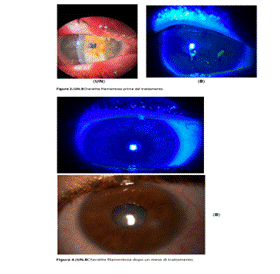
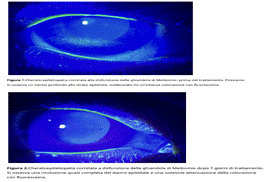
The clinical images illustrate the progression described.

In particular, Figures 1 and 2   show blepharo-kerato-epitheliopathy before treatment and after seven days: following treatment, there is an almost complete resolution of the epithelial damage and a marked reduction in fluorescein staining. 

Figures 3 and 4, on the other hand, show examples of filamentous keratitis before treatment and one month later. 

The potential effects of platelet lysate may depend on the anti-inflammatory and regenerative properties of umbilical cord blood. Platelets contain growth factors and cytokines involved in tissue repair processes.

In the context of ocular GvHD, characterised by inflammation and fibrosis, treatment may contribute to the repair of the ocular surface and the modulation of the inflammatory environment.

Eye drops containing umbilical cord blood platelet lysate may therefore represent a promising therapeutic option for patients with GvHD and severe ocular surface abnormalities that are resistant to previous treatments. In the patients studied, improvements were observed in both symptoms and objective clinical parameters, with particularly significant results in the healing of corneal ulcers and no treatment-related adverse events reported during the observation period.

Umbilical cord blood donation is the simplest, painless and risk-free option for both mother and baby.

This donation represents an innovative therapeutic potential to improve the condition of many patients.

In conclusion, umbilical cord blood donation represents a choice of immense ethical and scientific value.

The possibility of converting unitsunsuitable for transplantation into blood components for non-transfusion use ensures that no donation is ever wasted: even when a unit does not meet the numerical requirements for a standard transplant, it is immediately converted into a vital therapeutic resource.

Choosing to donate means supporting research, innovative treatments and safeguarding a precious gift that restores independence and health to patients with serious eye conditions and kindles hope for the future by funding research and regenerative medicine.

Donating umbilical cord blood is a simple and safe act, capable of increasing treatment options and transforming what would otherwise be biological waste into a true gift of life.

Viewed 1 time

About the author

Giuseppa Tancredi

Giuseppa Tancredi

Senior Biologist – Laboratory Coordinator, Sciacca Cord Blood Bank, Italy

Giuseppa Tancredi is a Senior Biologist and Laboratory Coordinator at the Sciacca Cord Blood Bank, Italy. With experience in biobanking and Transfusion Medicine since 1999, she is an Accredia-certi...