There is a silent paradox in the prevention of colorectal cancer.
We have one of the most effective tools in modern medicine — colonoscopy — yet thousands of people still do not have one.
It is not because they do not understand its importance. Not because they lack access to healthcare. But because it is an invasive, uncomfortable and anxiety-inducing examination.
Bowel preparation, sedation, a whole day set aside for it, and often the fear of the result as well.
And so, many put it off, then put it off again. And they often turn up late.
And this is precisely where artificial intelligence is changing the rules of the game.
A stool sample and artificial intelligence
A team of researchers from the University of Geneva, led by Professor Mirko Trajkovski, has published a study in *Cell Host & Microbe* that opens up a radically new scenario.
The principle is simple and, at the same time, revolutionary.
We do not look for the tumour directly, we do not look for cancer cells, nor do we even look for occult blood.
Instead, we look for the biological signature that the tumour leaves in the gut microbiome.
When a colon tumour begins to develop, the gut’s bacterial ecosystem changes: some species increase, others decrease, whilst others appear abnormally.
It is as if the tumour were rewriting the gut flora even before symptoms appear.
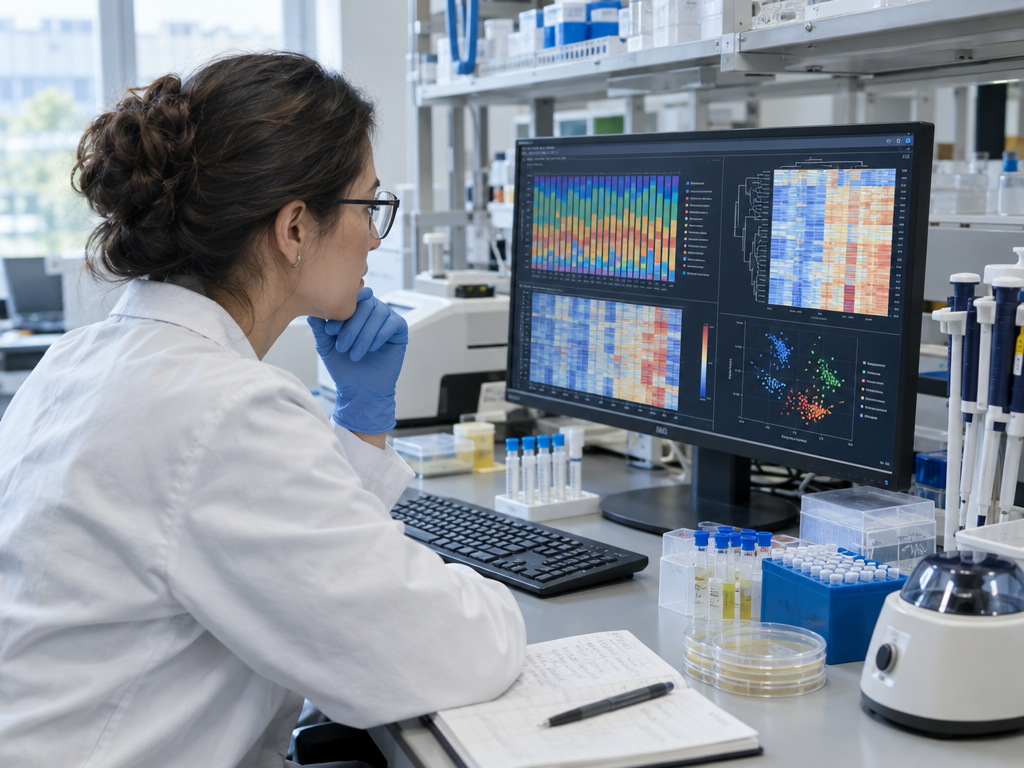
Artificial intelligence analyses these microscopic variations, identifies patterns invisible to the human eye and recognises the bacterial signatures typical of the neoplasm.
The result?
A stool sample, collected at home, can become an extraordinarily powerful diagnostic tool. 90 per cent versus 94 per cent: four percentage points that change everything
The figures are striking:
Colonoscopy: 94 per cent accuracy,
AI-assisted faecal test: 90% accuracy
Just four percentage points separate an invasive test from a sample collected at home
Four percentage points – and no tubes, no sedation, no bowel preparation.
From a clinical point of view, this difference is minimal. From a public health perspective, it is enormous.
Because the real problem with colorectal cancer screening is not the effectiveness of colonoscopy, but patient adherence.
Many people do not undergo screening because they fear it; many put it off because they find it inconvenient; many give up because they don’t have the time.
A home test changes everything.
Early diagnosis: the real crux of the matter
Colorectal cancer is one of the most common cancers in Europe, but it is also one of the most treatable if diagnosed early.
When detected at an early stage, the survival rate exceeds 90 per cent, and treatments are less invasive, whilst quality of life remains high
The problem isn’t the treatment; the problem is getting there in time.
And this is where artificial intelligence can make a difference.
A future home-based test based on this approach could encourage participation in screening.
And when participation increases, so does early diagnosis.
And when early diagnosis increases, mortality decreases.
It’s a simple chain.
But extremely powerful.
The microbiome: the new frontier of predictive medicine
This study also opens up another, even more fascinating scenario.
The gut microbiome is not merely a passive indicator; it is a dynamic system that reflects: inflammation, metabolism, diet, immunity and tumour development
Artificial intelligence enables these signals to be interpreted in an integrated manner.
No longer just a single biomarker.
But a complex biological signature.
&Medicine is moving from diagnosing disease to anticipating it. We no longer look for the tumour when it is obvious; instead, we detect the biological signals that precede the tumour.
This is the real revolution.
The clinical trial is already underway; the study is not merely theoretical, it is already underway at the Geneva University Hospitals (HUG).
The aim is to understand: which stages of the tumour are best identified, how effective it is in precancerous polyps, and how to integrate the test into screening programmes.
If the results are confirmed, the future could look very different.
A simple annual home-based screening could be carried out: a sample collected at home, an algorithm that flags up the risk, and only those who test positive are referred for a colonoscopy.
It does not replace, but rather anticipates: this test does not eliminate the colonoscopy, which remains the diagnostic and therapeutic standard because it allows us to visualise, take biopsies and remove polyps, but artificial intelligence can better identify who needs to undergo the procedure.
To put it more simply: fewer unnecessary colonoscopies, more targeted colonoscopies,
more early diagnoses – and this is smart medicine, it is sustainable healthcare, it is true prevention.
The real revolution: making prevention easy
The history of medicine teaches us one thing: the innovations that truly change public health are those that simplify access, as we have seen with the vaccine, with blood pressure and blood glucose monitoring, and, now, perhaps even with colorectal cancer screening.
Because, as I often argue, sometimes the real revolution is not technological, but behavioural and cultural.
A test that can be taken at home is a test that people take.
And when people take preventive measures, medicine really does change.
Artificial intelligence does not replace the doctor, it does not replace a colonoscopy, it does not replace clinical practice, but it helps to detect problems earlier.
And, in oncology, detecting problems earlier means better treatment, it means saving lives, it means turning fear into prevention.
Bibliography
Trajkovski M. et al. Artificial intelligence–based microbiome signatures for early detection of colorectal cancer. Cell Host & Microbe. 2024.
Wirbel J. et al. Meta-analysis of faecal metagenomes reveals global microbial signatures of colorectal cancer. Nature Medicine. 2019.